

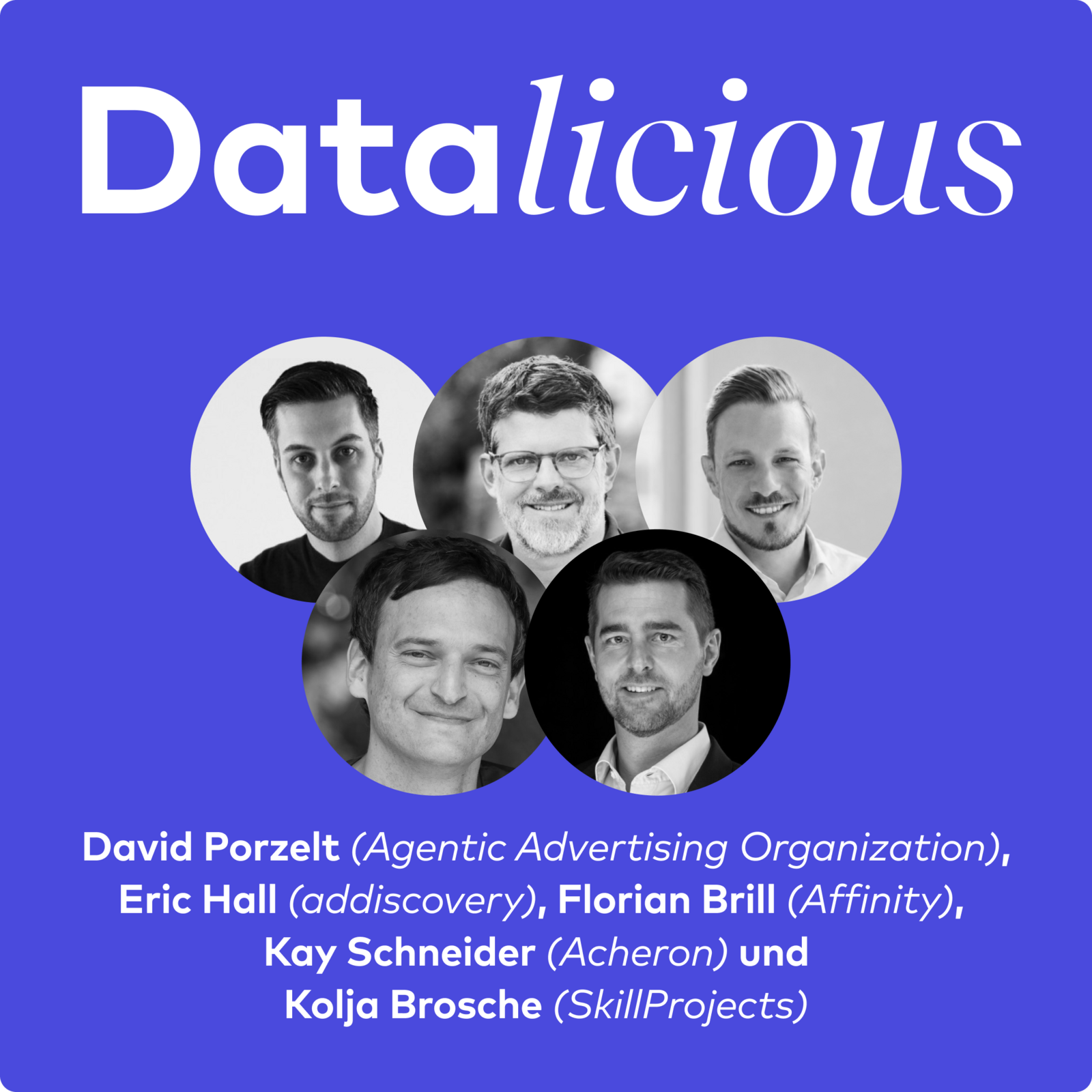
In this special edition of Datalicious, Carsten Sander brings together five industry experts for a panel discussion on agentic advertising – the technology in which AI agents independently plan, buy, and optimize ads. Eric Hall (Addiscovery), David Porzelt (AgenticAdvertising.org), Kay Schneider (Acheron), Florian Brill (Affinity), and Kolja Brosche (SkillProjects) provide an honest assessment of the current situation: The technology is ready, standards are evolving at an unprecedented pace, but the German market is still hesitant. The panel discusses why, despite enormous interest, hardly any genuine agentic campaigns are running; what could make Q4 of this year a decisive turning point; and how the business models of publishers, agencies, and manufacturers will fundamentally change over the next two years.
Topics discussed in this episode:
- The state of agentic advertising today: Where does the German market really stand when it comes to agent-based media planning and booking – and why is there such a wide gap between technological maturity and practical implementation?
- Standards, protocols, and infrastructure: What role do AdCP, MCP servers, and open protocols play in building an agent-based advertising ecosystem, and why is infrastructure the critical backbone of this development?
- Machines as new target group: What does it mean for manufacturers, retailers, and publishers when purchasing and booking decisions are no longer made by people, but by AI agents?
- Outlook and catalytic moments: What needs to happen for agentic advertising to truly scale in the DACH market, and what specific developments can we expect over the next six months to two years?
Takeaways from this episode
- The chicken-and-egg problem is holding back the market: The technology and standards, such as AdCP 3.1, are available. But hardly anyone is implementing them, so there are no requests – and vice versa. Publishers and agencies that become AdCP-ready now can position themselves as the first choice for buying agents in the DACH market.
- Q4 will be a stress test: WPP has announced that, starting in September, it will process CTV bookings via agent-to-agent communication – with Disney, Netflix, and Paramount on board. Combined with the expected launch of the ChatGPT Ads solution in Germany, this could trigger a decisive shift in advertising budgets.
- If you’re not machine-readable, you don’t exist: Manufacturers and publishers must structure their product and inventory data such that AI agents can find, evaluate, and process it. The semantic depth, completeness, and consistency of the data will become a matter of survival in the agentic age.
- Measurement determines adoption: The German market demands proof before investing. Without robust effectiveness studies and comparability to existing channels, it will be difficult to win over advertisers and agencies for the agentic approach. This precisely is still the biggest gap.
Chapters
00:00 – Introduction: The contradiction between technology pace and market inertia
04:52 – Yahoo, Ad Discovery, and the optimistic mood of the agentic market
09:05 – Yahoo’s positioning for the open web and the AdCP standard
11:46 – AdCP 3.1, new media formats, and the DACH chapter
14:21 – Why infrastructure is the key to agentic advertising
18:57 – AI for efficiency gains vs. AI for value creation at Affinity
28:50 – Machines as target group – what manufacturers must do now
33:03 – Real-world check: Why are there still so few genuine agentic campaigns?
38:20 – Supply, demand, and the chicken-and-egg problem in the German market
45:30 – Measurement and proof of effectiveness as driver of adoption
52:28 – Walled gardens vs. open web via agent interfaces
57:12 – What needs to happen for agentic to scale?
1:08:54 – The future of agencies: in-house teams, buying agents, and new roles
1:15:44 – Outlook: What will happen in the next six months?
1:28:12 – Time machine: What will the industry look like in two years?